
Test your defenses with Red Team Operations
Go beyond traditional penetration testing. Our red team operators simulate real-world adversaries, combining technical exploitation, social engineering, and physical intrusion to test your organization's true resilience against sophisticated attacks.

Why Red Team testing is essential
Traditional security testing finds technical vulnerabilities. Red teaming tests whether your people, processes, and technology can actually stop a determined attacker.
Security testing gaps Red Teams expose
Compliance-driven testing and vulnerability scans don't tell you if your organization can actually stop attackers. Red teaming answers the real question: can you detect and respond?
Checkbox security
Annual pentests check compliance boxes but don't reflect how real attackers operate: with time, persistence, and creativity.
Detection blind spots
You've invested in EDR, SIEM, and SOC. But can they actually detect sophisticated attacks? Most organizations don't know until it's too late.
Untested response
Incident response plans look good on paper. But does your team know what to do when alerts fire at 3 AM?
Human factor
Technical controls are strong, but one convincing phish bypasses everything. Social engineering remains the top attack vector.
Physical security
Tailgating, badge cloning, USB drops: physical attacks often aren't tested but can completely compromise technical controls.
Siloed testing
Separate tests for network, application, and social engineering miss how attackers chain techniques across domains.
Evolving threats
APT groups continuously adapt. Last year's defenses may not stop this year's techniques.
Defense assumptions
Security teams assume controls work. Red teaming validates or invalidates those assumptions with evidence.
Regulatory requirements
TIBER-EU, DORA, CBEST, and sector regulations increasingly require threat-led testing, not just vulnerability assessment.
Benefits of Red Team testing
Objective-based testing that reveals your true security posture against sophisticated adversaries.
Realistic attack simulation
Our operators use the same techniques as real threat actors: custom malware, living-off-the-land, social engineering, and physical intrusion.
APT-level TTPs mapped to MITRE ATT&CK
Know if you can stop nation-state-level attacks
Detection validation
Test whether your security controls and SOC can actually detect sophisticated attacks in progress.
Identify detection gaps and tuning opportunities
Validate your security investment ROI
Response testing
Exercise your incident response capabilities under realistic conditions without the damage of a real attack.
Stress-test playbooks and team coordination
Ensure business continuity during incidents
Purple team collaboration
Optional collaborative mode where attackers and defenders work together to maximize learning and improvement.
Real-time feedback and detection engineering
Accelerated security capability improvement
TIBER-EU / CBEST compliance
Meet regulatory requirements for threat-led penetration testing in financial services and critical infrastructure.
Structured methodology with threat intelligence
Regulatory compliance with actionable outcomes
Measurable improvement
Clear metrics on detection times, response effectiveness, and security gaps with roadmap for improvement.
Prioritized remediation based on attack paths
Board-ready reporting on security posture
Red Team engagement types
From focused adversary simulations to full-scope threat-led testing, we tailor engagements to your objectives and regulatory requirements.
Objective-Based Testing
Attack campaigns focused on achieving specific objectives: data exfiltration, domain compromise, or business disruption.
Extended Campaigns
Multi-week engagements simulating persistent adversaries with realistic dwell time and operational security.
Multi-Vector Attacks
Combine technical exploitation, social engineering, and physical intrusion like real threat actors.
Detection Evasion
Custom tooling and techniques to evade your security controls—testing detection, not just prevention.
Threat Intelligence Phase
Bespoke threat intelligence identifying APT groups and TTPs most likely to target your organization.
Red Team Testing
Intelligence-led attack simulation executing scenarios developed from threat intelligence.
Blue Team Assessment
Evaluate detection and response capabilities against the executed attack scenarios.
Regulatory Reporting
Complete documentation meeting TIBER-EU, CBEST, or AASE requirements for regulators.
Collaborative Testing
Red and blue teams work together, with real-time feedback on attack techniques and detection opportunities.
ATT&CK Coverage
Systematically test detection coverage across MITRE ATT&CK techniques relevant to your threat model.
Detection Engineering
Help your team build and tune detection rules based on observed attack techniques.
Capability Building
Build internal red/purple team capabilities through knowledge transfer and training.
APT Emulation
Simulate specific threat actors (APT28, Lazarus, FIN7, etc.) based on documented TTPs.
Ransomware Simulation
Test defenses against ransomware attacks without actual encryption; detection and response focus.
Cloud Attack Simulation
Test cloud-specific attack paths targeting AWS, Azure, or GCP environments.
Supply Chain Attacks
Simulate attacks through third-party relationships and software supply chain.
Social Engineering
Targeted phishing, vishing, and pretexting campaigns against specific roles and individuals.
Physical Intrusion
Test physical security controls: tailgating, badge cloning, lock bypass, and facility access.
USB & Device Drops
Assess risk from malicious USB devices and rogue hardware in your environment.
Wireless Attacks
Test wireless network security including rogue AP, evil twin, and WPA attacks.
All engagements follow TIBER-EU methodology and are mapped to MITRE ATT&CK framework. Plan your engagement →
Enterprise-grade Red Team evaluation
Our methodology aligns with TIBER-EU, CBEST, and AASE frameworks while remaining flexible to your specific objectives and constraints.
Scoping & Rules of engagement
Define objectives, scope, constraints, and establish rules of engagement with all stakeholders.
Threat intelligence & targeting
Gather intelligence on your organization and develop attack scenarios based on relevant threats.
Initial access
Execute initial access attempts through phishing, exploitation, physical intrusion, or other vectors.
Post-exploitation & Objectives
Maintain persistence, move laterally, escalate privileges, and work toward defined objectives.
Detection & Response assessment
Analyze blue team detection and response throughout the engagement. What was caught? What was missed?
Reporting & Remediation
Comprehensive reporting with attack narrative, findings, and prioritized remediation roadmap.
Red Team engagement deliverables
Comprehensive documentation that drives security improvement, not just checkbox compliance.
Executive summary
Board-ready summary of engagement objectives, outcomes, and strategic recommendations.
- Business impact
- Risk assessment
- Key findings
- Strategic recommendations
Attack narrative
Complete story of the attack from reconnaissance through objective achievement.
- Timeline
- Attack path
- Techniques used
- Detection evasion methods
Technical findings
Detailed documentation of all vulnerabilities and weaknesses exploited.
- Vulnerability details
- Exploitation method
- Evidence
- Remediation guidance
MITRE ATT&CK mapping
All attack techniques mapped to ATT&CK framework with detection recommendations.
- Technique coverage
- Detection gaps
- Priority techniques
- Detection rules
Detection analysis
Assessment of what your security controls detected, missed, and almost caught.
- Alert timeline
- Detection rate
- Near misses
- Tuning opportunities
Response assessment
Evaluation of incident response effectiveness during the engagement.
- Response times
- Escalation paths
- Containment effectiveness
- Playbook gaps
Remediation roadmap
Prioritized plan for addressing findings based on risk and attack paths.
- Priority ranking
- Quick wins
- Strategic improvements
- Timeline
Detection engineering
Custom detection rules and queries for the techniques used during testing.
- SIEM rules
- EDR detections
- YARA rules
- Sigma rules
Board presentation
Presentation deck for executive and board communication.
- Risk overview
- Business impact
- Improvement roadmap
- Investment guidance
Attack demonstration
Recorded demonstration of key attack paths for training and awareness.
- Screen recordings
- Narrated walkthrough
- Impact demonstration
TIBER/CBEST reports
Regulatory-compliant documentation for TIBER-EU, CBEST, or AASE submissions.
- Framework alignment
- Authority format
- Remediation attestation
Debrief sessions
In-depth technical debrief with your security team and lessons learned.
- Attack walkthrough
- Q&A
- Detection discussion
- Knowledge transfer
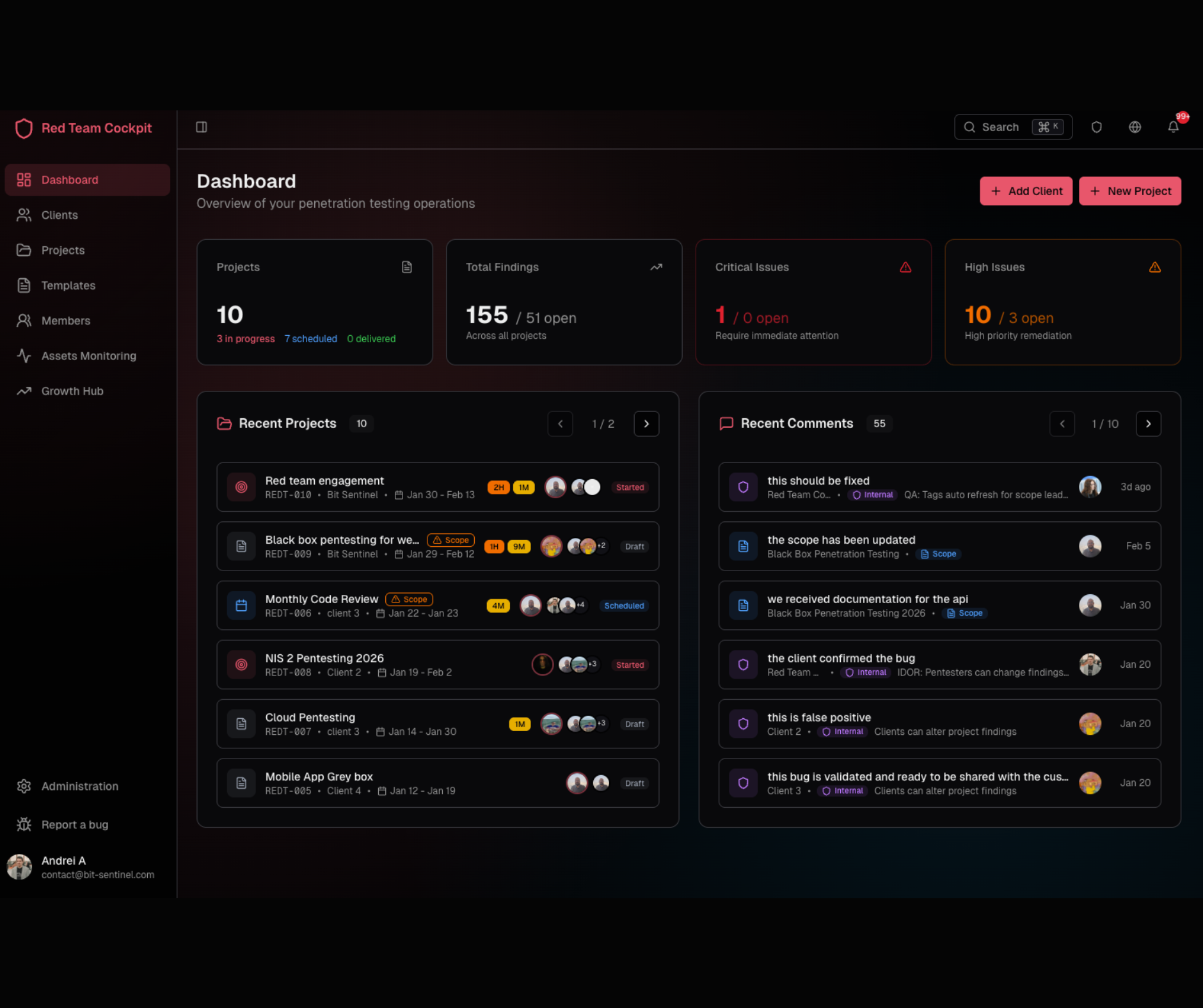
See the Platform in Action
Track engagement progress, view findings in real-time, and collaborate with our expert team through our secure client portal.
- Comprehensive security testing
- End-to-end encryption for all data
- Reports that actually get read - clear executive summaries
- Real time access to findings
Frequently asked questions
Penetration testing focuses on finding vulnerabilities within a defined scope and timeframe. Red teaming simulates real adversaries, using any technique (technical, social, physical) over extended periods to achieve specific objectives. Pentests answer "what vulnerabilities exist?" Red teams answer "can you actually stop an attacker?"
TIBER-EU (Threat Intelligence-Based Ethical Red Teaming) is a European framework for threat-led penetration testing, primarily for financial institutions and critical infrastructure. If you're regulated under DORA, operate in financial services, or are critical infrastructure, you may be required to conduct TIBER testing. We're certified to deliver TIBER-EU, CBEST (UK), and AASE (Singapore) engagements.
Full red team engagements typically run 4-12 weeks, reflecting realistic adversary timelines. TIBER-EU engagements are often 12-16 weeks including threat intelligence phases. Purple team exercises can be shorter (1-2 weeks) when focused on specific techniques. We tailor duration to your objectives.
Yes, with careful controls. Real attacks on real systems are essential for realistic testing. We establish clear rules of engagement, maintain constant communication, and have immediate rollback procedures. Certain high-risk actions (like actual data destruction) are simulated rather than executed. Safety is paramount.
Our operators are experienced professionals who understand production environments. We've conducted hundreds of engagements without causing business disruption. Rules of engagement define boundaries, we avoid high-risk techniques without approval, and we have immediate rollback procedures. That said, realistic testing does carry some risk, which is why rules of engagement are so important.
It depends on your objectives. "Blind" testing where SOC doesn't know provides realistic detection assessment but can waste analyst time. "Announced" testing allows focus on specific detection gaps. Many clients use a hybrid: leadership knows, but front-line analysts don't. We recommend discussing this during scoping.
Purple team is collaborative testing where red and blue teams work together with full transparency. It's ideal when you want to maximize learning and detection improvement rather than test "blind" detection. We often recommend starting with purple team to build detection capabilities, then validating with a blind red team later.
Yes. Off-the-shelf tools get caught by modern defenses. Our operators develop custom implants, modify existing tools, and use living-off-the-land techniques to evade detection. This reflects how real APT groups operate. All custom tooling is removed and documented at engagement end.
Absolutely. Cloud attack paths, e.g. IAM privilege escalation, cross-account pivoting, serverless exploitation, are core capabilities. We test AWS, Azure, GCP, and hybrid environments. Cloud-specific rules of engagement ensure we don't violate provider terms of service.
Our red team operators hold OSCP, OSEP, CRTO, CRTL, GPEN, and other offensive security certifications. More importantly, they have years of real-world experience across hundreds of engagements. Certifications demonstrate baseline knowledge; experience is what matters.
Elite Red Team operators
Our operators combine offensive certifications with years of real-world experience
Test your defenses like real attackers would.
Find out if your security controls, people, and processes can actually stop sophisticated adversaries. Before real attackers find out for you.