
Web Application Penetration Testing. Find vulnerabilities before attackers do.
Your web applications are your business. Our expert testers go beyond automated scans to uncover the vulnerabilities that matter: authentication bypasses, business logic flaws, injection attacks, and the complex chains attackers actually exploit.
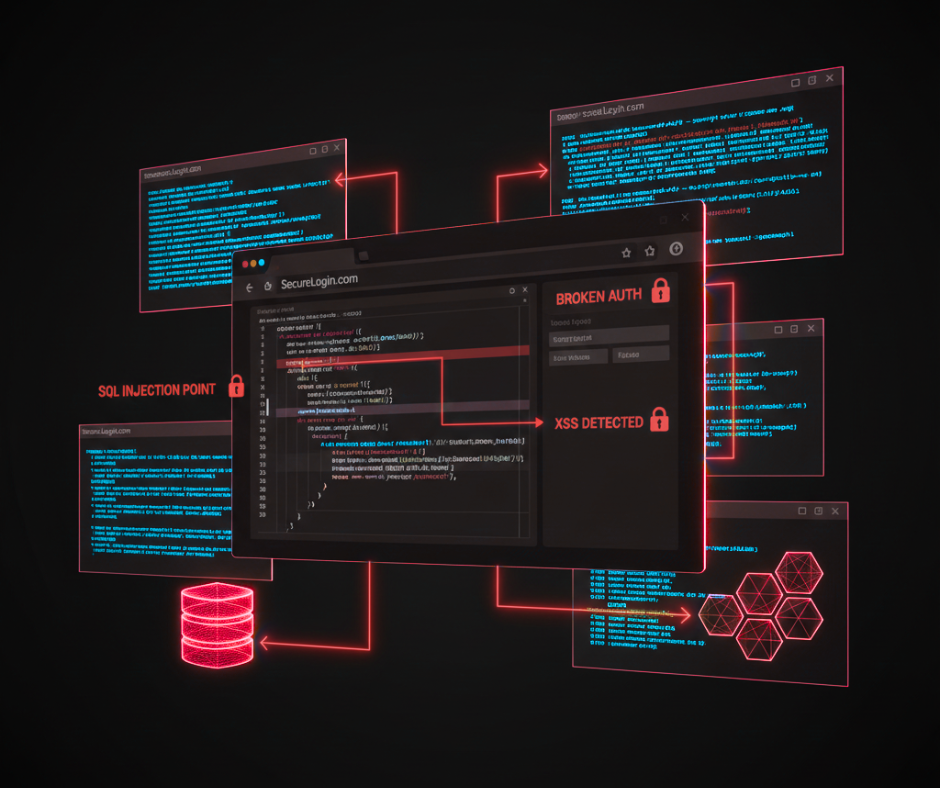
Web application security by the numbers
Web applications are the #1 attack vector for data breaches. Most vulnerabilities are exploitable within hours of discovery.
Web application security risk at scale
Modern web applications introduce complex attack paths that increase exposure across the business and strain traditional security controls.
Complex modern stacks
React, Angular, Vue frontends with Node, Python, Java backends. Microservices, APIs, serverless: each layer has its own attack surface.
Continuous deployment
Daily releases mean daily new vulnerabilities. Traditional annual pentests can't keep up with modern CI/CD pipelines.
Authentication complexity
OAuth, SAML, JWT, MFA: authentication is harder than ever. One misconfiguration and attackers have the keys.
Business logic flaws
Scanners miss business logic vulnerabilities. IDOR, privilege escalation, workflow bypasses require human intelligence.
Third-party dependencies
npm, pip, Maven: your app is 80% third-party code. One vulnerable dependency and you're exposed.
API-first architecture
APIs power mobile apps, integrations, and microservices. They're often poorly documented and inconsistently secured.
False sense of security
WAFs and automated scanners give confidence, but attackers bypass them daily. You need human expertise.
Compliance requirements
PCI DSS, SOC 2, ISO 27001, GDPR: all require regular security testing. Checkbox compliance isn't real security.
Developer security skills
Developers build features, not security. Without expert review, vulnerabilities slip into production.
Main benefits of professional web application testing
Expert manual testing finds what automated tools miss: the vulnerabilities attackers actually exploit.
Find real vulnerabilities
Manual testing by certified experts uncovers business logic flaws, chained attacks, and context-specific vulnerabilities scanners miss.
Detailed PoC with reproduction steps, code-level root cause analysis
Prioritized risk assessment with business impact context
Validate security controls
Test your WAF, rate limiting, input validation, and authentication mechanisms under real attack conditions.
Control effectiveness testing, bypass documentation, configuration guidance
Confidence that security investments actually work
Meet compliance requirements
Generate audit-ready evidence for PCI DSS, SOC 2, ISO 27001, and GDPR. Reports mapped to compliance frameworks.
CVSS scores, CWE mapping, remediation priorities
Audit-ready reports, compliance evidence, reduced regulatory risk
Improve developer skills
Findings include root cause analysis and secure coding guidance. Your team learns from every test.
Code examples, fix recommendations, security training opportunities
Reduced future vulnerabilities, improved security culture
Protect customer data
Identify data exposure risks before attackers find them. Protect PII, credentials, and sensitive business data.
Data flow analysis, encryption validation, access control testing
Brand protection, customer trust, breach prevention
Enable secure growth
Launch new features and products with confidence. Security testing that keeps pace with your roadmap.
Integration with CI/CD, pre-release testing, API coverage
Faster time-to-market, competitive advantage, customer confidence
Full scope web application penetration testing services
From traditional web apps to modern SPAs and APIs, we cover the full spectrum of web application security.
Full-Stack Web Application Testing
Comprehensive security assessment of your web applications including frontend, backend, database, and infrastructure layers. OWASP Top 10 coverage plus advanced attack techniques.
Learn MoreREST & GraphQL API Testing
APIs are the backbone of modern applications. We test REST, GraphQL, and SOAP APIs for authentication, authorization, injection, and business logic vulnerabilities.
Learn MoreSingle Page Application Security
React, Angular, Vue, and other SPA frameworks introduce unique security challenges. We test client-side logic, state management, and API integrations.
Learn MoreAuthentication & Access Control
Deep-dive testing of authentication mechanisms, session management, and access controls. From password-based auth to complex SSO implementations.
Learn MoreBusiness Logic Testing
Automated tools miss business logic flaws. Our testers understand your application workflow to identify logic bypasses, race conditions, and abuse scenarios.
Learn MoreCloud-Native Application Testing
Serverless, containers, and cloud-hosted applications have unique security considerations. We test the application and its cloud context.
Learn MoreE-Commerce & Payment Security
Specialized testing for e-commerce platforms, payment integrations, and PCI DSS compliance. Protect transactions and customer financial data.
Learn MoreContinuous Security Testing
For organizations with frequent releases, we offer continuous testing integrated with your development workflow. Security that keeps pace with DevOps.
Learn MoreHow we test your web applications
Our methodology combines industry standards (OWASP, PTES) with practical attacker tradecraft. Here's how we approach every engagement.
Scoping & Reconnaissance
We understand your application architecture, technology stack, and business context. Define scope, rules of engagement, and success criteria.
Automated scanning
Industry-leading scanners identify known vulnerabilities, misconfigurations, and low-hanging fruit. This is the starting point, not the end.
Manual testing
Expert testers probe authentication, authorization, business logic, and application-specific attack vectors that tools miss.
Exploitation & Validation
We just find vulnerabilities and prove their impact. Safe exploitation demonstrates real-world risk without causing damage.
Reporting & Debrief
Comprehensive report with executive summary, technical details, and actionable remediation. Live debrief to answer all questions.
Retesting
After you remediate, we verify fixes are effective. Included retesting ensures vulnerabilities are truly resolved.
Actionable deliverables
Clear, comprehensive reports designed for both technical teams and executive stakeholders.
Executive summary
Board-ready overview with risk ratings, business impact, and strategic recommendations.
- Risk score
- Business impact
- Key findings
- Strategic recommendations
Technical report
Detailed vulnerability documentation with reproduction steps, screenshots, and code samples.
- CVSS scores
- CWE mapping
- PoC steps
- Screenshots/videos
Remediation guidance
Fix-ready recommendations with code examples and configuration changes.
- Code fixes
- Config changes
- Priority order
- Effort estimates
Compliance mapping
Findings mapped to PCI DSS, SOC 2, ISO 27001, and other relevant frameworks.
- PCI DSS
- SOC 2
- ISO 27001
- OWASP ASVS
Retest report
Verification report confirming remediation effectiveness. Clean letter available.
- Fix verification
- Regression check
- Delta report
- Attestation letter
Live debrief
Presentation to technical and executive stakeholders with Q&A.
- Findings walkthrough
- Attack demos
- Q&A session
- Remediation planning
Frequently asked questions
Answers to common questions about web application penetration testing.
A typical web application pentest takes 5-10 business days depending on application complexity, number of user roles, and API endpoints. Simple marketing sites might take 3-5 days, while complex SaaS platforms with multiple user types could take 2-3 weeks. We provide accurate timelines after scoping.
We prefer testing in staging environments when possible. When production testing is required, we use safe techniques that won't cause denial of service, data corruption, or affect real users. We coordinate testing windows and have rollback procedures. In 11+ years, we've never caused a production outage.
Automated scanners find known vulnerabilities and misconfigurations. Penetration testing adds human intelligence to find business logic flaws, authentication bypasses, complex attack chains, and context-specific vulnerabilities that scanners miss. We use scanners as a starting point, not a replacement for manual testing.
Yes, authenticated testing is critical. We test with different user roles to identify privilege escalation, IDOR, and horizontal/vertical authorization flaws. You'll provide test accounts for each role, or we can work with your team to set them up.
For comprehensive testing, we need: test accounts for each user role, API documentation (if available), access to staging environment, VPN credentials (if applicable), and any WAF/security tool whitelisting. We provide a detailed checklist during scoping.
All testing is conducted under NDA. Any sensitive data discovered is documented only as necessary to prove the vulnerability (with redaction where possible). Data is stored encrypted and deleted according to our data retention policy. We never exfiltrate or retain customer data.
Yes. Our reports include detailed remediation guidance with code examples where applicable. After the report, we're available for questions during your remediation. Retesting is included to verify fixes are effective.
We recommend annual comprehensive testing at minimum. High-change environments benefit from quarterly testing or continuous testing programs. After major releases, new features, or architectural changes, targeted testing of affected areas is advisable.
Yes. API testing is a core capability. We test REST, GraphQL, and SOAP APIs whether they're consumed by web applications, mobile apps, or third-party integrations. For comprehensive mobile security, we also offer dedicated mobile application penetration testing.
Web application penetration testing satisfies requirements in PCI DSS (Requirement 11.3), SOC 2 (Common Criteria), ISO 27001 (A.14.2.8), HIPAA technical safeguards, and most industry-specific regulations requiring security testing. Our reports include compliance mapping.
Certified security professionals
Our testers hold industry-recognized certifications and have real-world experience attacking and defending web applications
Your web applications are under constant attack.
Every day you wait is another day attackers have to find your vulnerabilities first. Our expert testers are ready to help you identify and fix security issues before they become breaches.